Greetings, fellow English-speaking individuals! Today, I would like to discuss a fascinating topic with you that is widely used in various fields and has a significant impact on communication. Yes, I am referring to the NATO Phonetic Alphabet! This unique alphabet system is specifically designed to enhance clarity when spelling out words and names over the phone or radio.
Let’s Start with the Basics
The NATO Phonetic Alphabet, also known as the International Radiotelephony Spelling Alphabet, consists of a set of words assigned to each letter of the English alphabet. These words are carefully chosen to be easily distinguishable and sound distinct even in noisy or problematic communication channels.
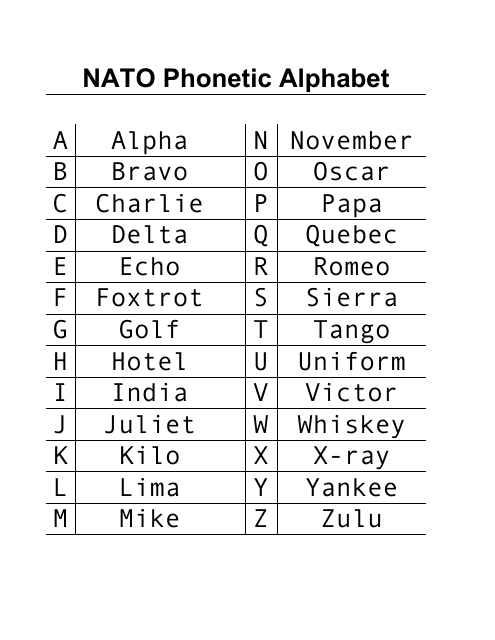 Now, you might wonder why such an alphabet is necessary at all. Well, imagine a scenario where you need to communicate critical information, like a street address or an important code, over a call or radio. Pronouncing letters aloud can lead to confusion due to similar sounding letters, accents, or background noises. That’s where the NATO Phonetic Alphabet comes to the rescue!
Let’s delve into the brilliance of this phonetic system by examining some of its key components:
Alpha, Bravo, Charlie…
 Each letter of the English alphabet is assigned a corresponding word in the NATO Phonetic Alphabet. For instance, the letter “A” is represented by the word “Alpha,” “B” by “Bravo,” “C” by “Charlie,” and so forth. These assigned words are universally recognized, making it easier for people from different language backgrounds to communicate effortlessly.
Here’s a useful tip: you can use these assigned words as mnemonics to remember important information. For example, if you need to remember that “S” stands for “Sierra,” you can imagine a soaring sierra mountain range in your mind!
Why Stop at Letters?
 The brilliance of the NATO Phonetic Alphabet doesn’t just end at individual letters. Numbers are also assigned specific words to avoid confusion during numeric communication. For instance, “0” is represented by “Zero,” “1” by “One,” “2” by “Two,” and so on. This clever inclusion ensures accurate transmission of numeric information, leaving no room for errors or misinterpretation.
So, whether you are a pilot communicating with air traffic control, a military professional relaying vital information, or even just a regular individual spelling out your email address to a customer service representative over the phone, the NATO Phonetic Alphabet is always there to make your communication efficient and precise.
It’s worth noting that there are variations of the phonetic alphabet used in different countries or organizations. However, the NATO Phonetic Alphabet is the most widely recognized and utilized globally. So, if you find yourself communicating with individuals from different backgrounds, deploying the NATO Phonetic Alphabet will ensure seamless understanding.
Now that you have familiarized yourself with this invaluable tool, you might be wondering how to get started in incorporating it into your daily communication. One excellent way is to practice by using the alphabet chart image provided. Memorize the assigned words to each letter and try spelling out common words or your name using the NATO Phonetic Alphabet. Soon enough, it will become second nature!
In Conclusion
As I conclude, it is clear that the NATO Phonetic Alphabet is a crucial aspect of clear and effective communication. By utilizing this brilliant system, we can avoid confusion, misunderstandings, and ensure accurate transmission of critical information. So, let’s embrace this powerful tool and enhance our communication skills!
Remember, the next time you find yourself spelling out something important over the phone or radio, embrace the alpha, bravo, charlie within you. Happy communicating!
